CampusNetworks
One Protected Fiber Path Across the Campus
Iron Photon armored fiber connects campus buildings and the technology inside them. Qualifying direct-burial backbones suitable for small-OD trenching or narrow-trench installation can reduce conventional conduit construction between facilities, while armored trunks and patch cords extend connectivity through data rooms, telecommunications spaces, Professional AV, DAS, security cameras and other building systems. Hybrid power-and-fiber and power-over-fiber solutions can be engineered for approved remote devices.
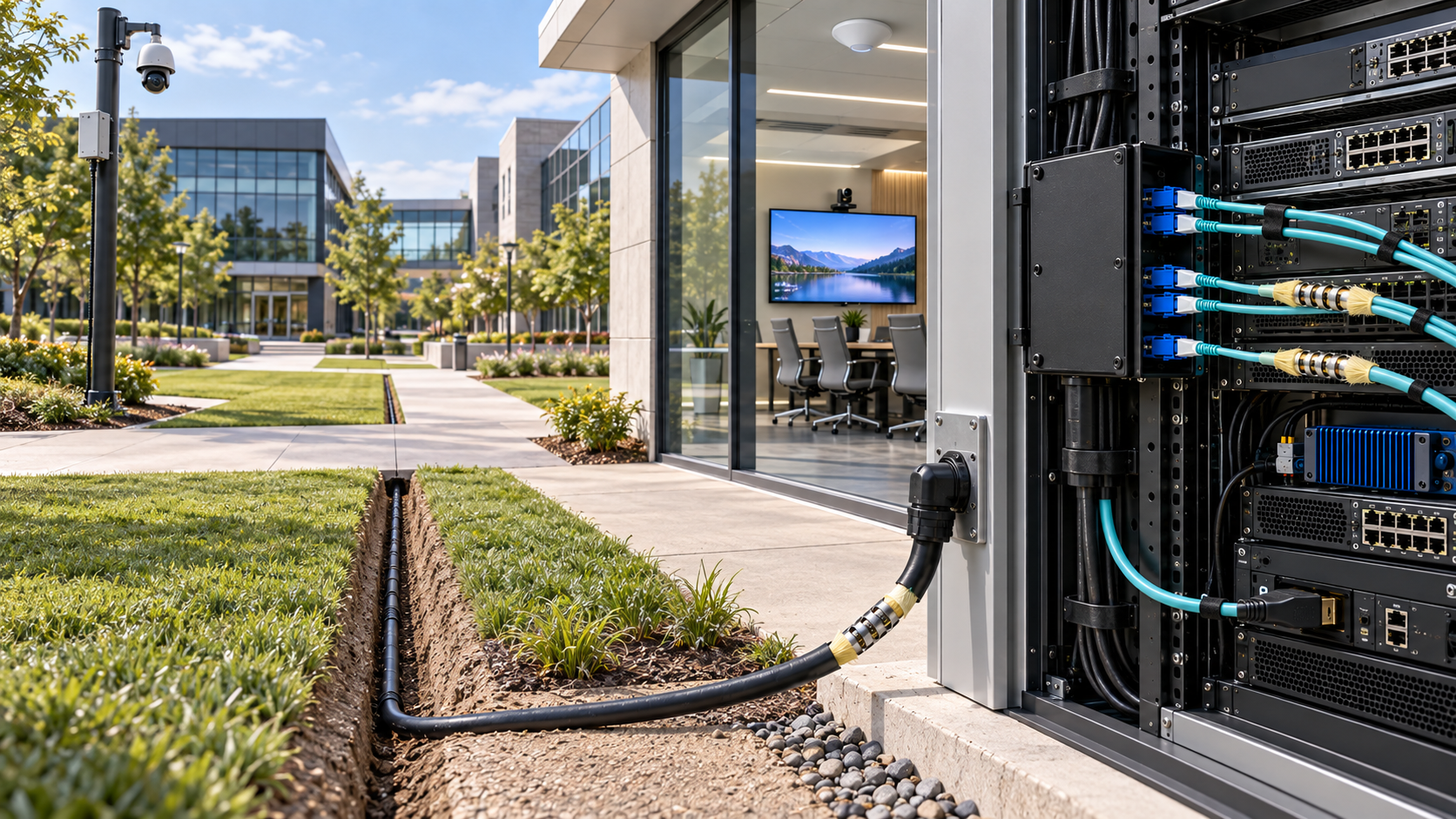
One Protected Fiber Path Across the Campus
Universities, healthcare systems, corporate campuses, government facilities and other multi-building environments depend on fiber to connect people, systems and operations. The campus backbone must carry network, video, voice, security, wireless and building-system traffic between facilities, then transition cleanly into the data and technology spaces inside each building.
Iron Photon combines high-performance optical fiber with compact stainless-steel spiral armor. The platform can protect the interbuilding backbone and continue through factory-terminated trunks and smaller armored patch cords toward network, AV, DAS, camera and equipment interfaces.
From Direct Burial to the Building Interior
Iron Photon can coordinate the complete route: a qualifying outdoor armored backbone crosses the campus, enters the building through the approved service pathway, terminates in the data or telecommunications room and transitions through armored patching to systems throughout the facility.
The image models this path. A black armored OS2 backbone connects campus buildings through a narrow underground route, enters the building data room and transitions to aqua armored LC patch cords serving network and technology equipment. Conference-room AV, DAS and camera touchpoints are visible beyond the equipment room.
Campus Network Applications
Iron Photon armored fiber solutions can support:
- University and college campuses
- Healthcare and hospital campuses
- Corporate headquarters and multi-building office environments
- Government, municipal and public-safety facilities
- Research laboratories and technology parks
- Industrial and manufacturing campuses
- Hotels, resorts and convention properties
- Stadium, arena and entertainment complexes
- Transportation, airport and operations campuses
- Data, voice, video and building-system networks
- Security, surveillance and access-control systems
- Commercial cellular and qualifying public-safety DAS infrastructure
Relevant Iron Photon Campus Solutions
- OS2 singlemode armored backbone fiber for interbuilding links
- OM3, OM4 and OM5 multimode armored fiber where applicable
- Direct-burial constructions for approved routes and soil conditions
- Compact constructions suitable for qualifying small-OD or narrow-trench installations.
- Indoor, outdoor and indoor or outdoor cables where available
- Armored rollable-ribbon fiber for qualifying high-count backbones
- Factory-terminated trunks, breakouts and armored patch cords
- LC, SC and MTP/MPO interfaces where appropriate
- Hybrid power-and-fiber for project-specific remote equipment
- Power-over-fiber systems for qualifying low-power endpoints
- Armored active optical HDMI and Professional AV connectivity
- Fiber supporting DAS headend, distribution and remote-unit links
- Custom lengths, fiber counts, labels and factory test documentation
Final cable, jacket, water blocking, burial method, fiber count, connector, fire rating, pathway, environmental rating, power design and equipment compatibility must be confirmed for the exact part number and approved campus design.
Direct Burial and Small OD Trenching Between Buildings
Conventional interbuilding construction may require a wide trench, conduit, pull boxes, extensive restoration and a separate cable-pulling phase. For approved routes, direct-burial cable installed using small-OD or narrow-trench methods can reduce pathway materials, excavation, restoration and installation steps.
Potential project advantages include:
- Less excavation and backfill than many conventional trench methods
- Reduced conduit and pull-box requirements where approved
- Smaller restoration footprint across qualifying campus routes
- Faster linear installation and earlier network availability
- Reduced disruption to roads, walkways, lawns and occupied facilities
- Potentially lower total installed cost for qualifying projects
These benefits are project-dependent. Route surveys, utility locating, permits, soil and pavement conditions, drainage, approved depth, separation, crossings, water blocking, restoration, future access and maintenance strategy must be evaluated before selection.
Interbuilding Data and Network Backbones
OS2 singlemode fiber can connect data rooms, network cores, edge facilities and remote buildings across extended distances when paired with compatible active optics and a validated loss budget. High-count and rollable-ribbon options can support growth and backbone consolidation where the exact construction is approved.
Topology, redundancy, route diversity, bandwidth, fiber count, splice plan, entrance protection, grounding or bonding and future capacity should be coordinated as part of the campus network architecture.
Data Rooms Telecommunications Spaces and Equipment Patching
After the campus backbone enters a building, it may pass through entrance facilities, data rooms, intermediate telecommunications rooms, AV spaces and equipment cabinets. Iron Photon factory-terminated trunks and armored patch cords can extend cable-level protection toward switches, optical interfaces and distribution hardware.
Connector type, polarity, channel mapping, breakout, bend radius, rack entry, fire rating, labeling and test documentation must match the complete installed link.
As a typical guideline, minimum bend radius is 20× the cable outside diameter during installation and 10× after installation. Requirements vary by cable construction; confirm the applicable values for the selected cable and installation conditions.
Professional AV Inside Every Building
Campus connectivity supports conference rooms, classrooms, lecture halls, auditoriums, simulation spaces, command centers, digital signage, collaboration systems and venue displays. Fiber may connect centralized AV and network resources with cameras, encoders, decoders, processors, projectors, LED systems and room-control equipment.
Iron Photon can coordinate armored backbones, AV-over-IP links, equipment patching, tactical event fiber and active optical HDMI around the building and its technology. Bandwidth, latency, topology, active equipment and source-display compatibility remain part of the qualified AV design.
DAS Wireless and Mobile Coverage Touchpoints
Campus buildings may include commercial cellular DAS or public-safety radio infrastructure. Armored fiber can support qualifying links among DAS headend equipment, distribution locations and remote units while sharing a coordinated pathway strategy with data and AV systems.
DAS coverage, active equipment, power, monitoring, survivability, code compliance and authority acceptance remain part of the approved DAS design. Shared pathways must be coordinated so one system does not compromise another.
Security Cameras Sensors and Remote Devices
Fiber can connect campus cameras, perimeter systems, access-control locations, sensors and remote equipment over distances that may exceed conventional copper links. Armored cable adds protection along outdoor and building pathways where physical damage is a concern.
Camera resolution, bandwidth, active optical equipment, environmental exposure, power, mounting, cybersecurity and monitoring requirements must be designed as a complete system.
Hybrid Power and Fiber
Some campus cameras, wireless devices, displays and remote systems require optical connectivity and electrical power. Iron Photon can evaluate project-specific hybrid assemblies combining fiber and copper conductors.
Voltage, current, conductor size, voltage drop, length, connector system, pathway, temperature, electrical code and equipment requirements must be engineered for every design. Hybrid cable is not a universal replacement for separately designed power and communications infrastructure.
Power Over Fiber for Qualifying Campus Endpoints
Power over fiber transmits optical energy and converts it into electrical power at the remote end. For qualifying low-power cameras, sensors, monitoring devices and communications endpoints, it can reduce dependence on local outlets and avoids adding copper conductors to the optical power channel.
The system requires an optical-power transmitter, compatible fiber path, photovoltaic converter, load management, power margin and laser-safety controls. Output depends on wavelength, source power, distance, losses, efficiency, temperature and equipment demand. Metallic armor grounding, bonding and isolation must be evaluated separately for the complete installation.
Installer and Campus Technology Advantage
Campus project teams can benefit from:
- One coordinated platform from outdoor backbone to indoor equipment patching
- Potential reduction in conduit construction for qualifying routes
- Compact armor for crowded pathways and building entrances
- Factory termination that can reduce field labor
- OS2 and multimode options matched to distance and equipment
- Support for data, AV, DAS, security and building technology touchpoints
- Hybrid power-and-fiber and qualifying power-over-fiber engineering
- Custom breakouts, labeling, polarity and documentation
- Scalable backbone capacity for future buildings and systems
Engineered Around the Complete Campus Route
Iron Photon evaluates the campus topology, buildings, data rate, distances, redundancy, fiber count, route, burial method, entrances, data rooms, AV systems, DAS, cameras, power requirements, environmental exposure, connectors, fire ratings, grounding, testing and documentation before recommending a configuration.
Direct burial, small-OD trenching, power delivery, fire rating, environmental suitability, DAS performance and code compliance must never be inferred from armor alone. Each claim must correspond to the approved construction, complete system design, applicable requirements and supporting documentation.
Connect the Campus and Everything Inside It
Tell us about the buildings, route, network architecture, data rooms, AV spaces, DAS, cameras, remote devices, bandwidth, pathways and power requirements. Iron Photon will help determine the armored backbone, building trunks, equipment patching, hybrid cable and qualifying power-over-fiber approach required for the complete campus.