DataCentersandAIInfrastructure
Armored Fiber Built for High Capacity Networks
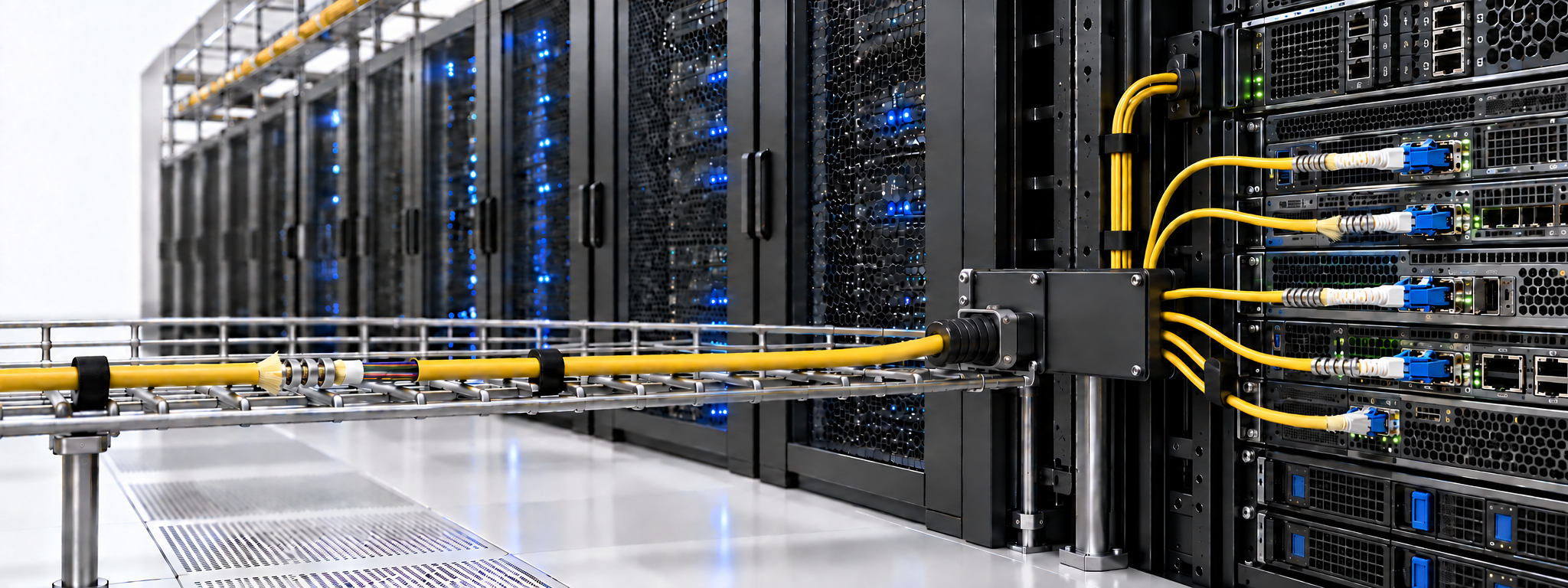
Iron Photon armored fiber helps protect the high-capacity optical pathways connecting AI clusters, switches, servers, storage systems, meet-me rooms and data-center distribution areas. Compact stainless steel armor, high-fiber-count constructions and project-specific terminations help installers place more protected capacity through congested pathways while supporting faster deployment, organized expansion and dependable long-term operation.
Armored Fiber Built for High Capacity Networks
Data centers and AI infrastructure require dense, scalable fiber connections among compute clusters, network fabrics, storage systems, patching fields, carrier rooms and interbuilding pathways. As bandwidth and fiber counts increase, physical pathway capacity and cable protection become critical parts of the network design.
Iron Photon combines high-performance optical fiber with compact stainless-steel spiral armor. The integrated construction adds cable-level protection while preserving the flexibility and smaller outside diameter needed for racks, trays, conduits, equipment rooms and high-density pathways.
Supporting AI Cloud and Hyperscale Growth
AI and high-performance computing environments continue to increase the number and speed of optical links required between compute, storage and network equipment. New capacity must often be installed within existing spaces where rack density, cooling, pathway utilization and deployment schedules are already constrained.
Iron Photon armored fiber can support new builds, phased expansions and qualifying brownfield upgrades with cable constructions engineered around fiber count, pathway, termination method, active equipment and future capacity requirements.
Compact Protection for High Density Pathways
Conventional protective systems can consume valuable pathway space or require additional installation steps. Iron Photon integrates stainless steel spiral armor directly around the protected optical core, helping reduce the need for a separate oversized protective layer where the selected construction and applicable installation requirements permit.
The compact armored design can help installers use conduit and cable-tray capacity more efficiently while reducing exposure to crushing, impact, kinking, pulling and other physical risks encountered during installation and system changes.
Data Center and AI Applications
Iron Photon armored fiber solutions can support:
- AI and high-performance computing clusters
- Hyperscale, colocation and enterprise data centers
- Spine-and-leaf network architectures
- Switch, server and storage connectivity
- Main and intermediate distribution areas
- Meet-me rooms and carrier interconnects
- Data halls, equipment rooms and telecommunications spaces
- High-density backbone and horizontal pathways
- Campus and interbuilding data-center connections
- Cloud, content-delivery and edge infrastructure
- Network expansion and capacity upgrades
- Backup, disaster-recovery and secondary facilities
- Security, monitoring and building-management networks
Relevant Data Center and AI Solutions
- OS2 singlemode armored fiber for extended-reach and high-capacity links
- OM3, OM4 and OM5 multimode armored fiber where applicable
- Armored rollable-ribbon fiber from 12 through 288 fibers for qualifying constructions
- Tight-buffered and loose-tube designs where applicable
- Indoor, outdoor and indoor or outdoor constructions
- Plenum, riser, low-smoke zero-halogen and project-specific jackets where available
- Factory-terminated trunk assemblies
- MTP/MPO, LC, SC and project-specific connector interfaces where appropriate
- Custom breakout and fanout assemblies
- Cassette-management and high-density patching solutions
- Rack-mounted and wall-mounted fiber enclosures
- Custom lengths, fiber counts, polarity and channel mapping
- Sequential footage markings, print legends and project-specific labeling
- Factory testing and documentation for qualifying assemblies
Final fiber type, fiber count, cable construction, outside diameter, jacket, fire rating, connector interface, polarity, environmental suitability and installation method must be confirmed for the selected part number and project.
AI and High Performance Computing Clusters
AI clusters connect large numbers of accelerators, servers, switches and storage systems through high-speed optical fabrics. These networks require dense physical-layer infrastructure that can support rapid deployment and future bandwidth growth without overwhelming racks and pathways.
Iron Photon can engineer armored cable, factory-terminated trunks, breakouts and high-density connectivity around the required link architecture. Compact armor helps protect critical optical pathways during rack installation, equipment refreshes and ongoing moves, additions and changes.
High Density Backbone Infrastructure
Data-center backbones must carry large fiber counts among entrance facilities, meet-me rooms, main distribution areas, intermediate distribution areas and equipment rows. High-count armored constructions can consolidate capacity while providing additional cable-level protection across shared pathways.
The appropriate design depends on fiber count, route length, pathway fill, bend radius, pulling conditions, termination method and future growth. Iron Photon can coordinate bulk cable, factory termination, breakout hardware and patching around the complete pathway.
Armored Rollable Ribbon Fiber
Iron Photon armored rollable-ribbon fiber combines high fiber density with a compact flexible ribbon structure. Fibers can be organized into ribbons for compatible mass-fusion splicing, helping installers splice multiple fibers simultaneously instead of processing each fiber individually.
For qualifying data-center and interbuilding applications, rollable ribbon can help reduce cable diameter, improve pathway utilization and shorten high-count splicing work. Final mass-fusion compatibility, fiber grouping, preparation method, splice equipment and enclosure capacity must be confirmed for the selected construction.
New Builds Expansions and Brownfield Upgrades
New data centers can incorporate armored fiber into the pathway strategy from the beginning. Existing facilities may require additional capacity through conduits and trays that already support active services.
Compact armored fiber can provide a practical option for qualifying upgrades where pathway space and physical protection both matter. Route surveys, fill calculations, bend requirements, fire ratings and installation methods must be evaluated before product selection.
Data Center Interconnect and Campus Links
Data-center interconnects may extend between buildings, carrier facilities, edge locations and disaster-recovery sites. OS2 singlemode armored fiber can support long-distance, high-bandwidth links when paired with compatible active optical equipment and a validated loss budget.
Indoor, outdoor and indoor or outdoor cable constructions can be selected according to the route, environment, pathway and applicable requirements. Direct-burial or conduit-free installation must never be assumed; suitability must be confirmed for the exact cable construction, route and governing code.
Factory Terminated Trunks and Breakouts
Factory-terminated trunks can reduce field termination labor and provide a predictable transition between backbone pathways, patching systems and active equipment. Assemblies can be configured with project-specific fiber counts, lengths, connector types, polarity, fanouts, pulling hardware and labels.
MTP/MPO, LC, SC and other interfaces can be incorporated where appropriate. Connector performance, gender, key orientation, pinning, polarity method, channel mapping and equipment compatibility must be verified for the complete optical channel.
Protection Where Data Centers Are Most Vulnerable
Fiber can be damaged during cable pulling, rack installation, equipment replacement, pathway changes and ongoing maintenance. A damaged backbone or equipment link can interrupt compute, storage, cloud services, security systems and customer operations.
Iron Photon stainless steel armor adds physical protection around the optical fibers while maintaining a compact and flexible construction.
The armor can help protect fiber in:
- Overhead and underfloor cable pathways
- High-density racks and equipment rows
- Meet-me rooms and carrier spaces
- Main and intermediate distribution areas
- Shared conduits and congested cable trays
- Interbuilding and campus routes
- Pathways exposed to future equipment changes
- Active facilities where service disruption must be minimized
Installer and Integrator Advantage
Iron Photon helps integrators combine optical capacity and protective armor within one coordinated cable construction.
Installers and integrators can benefit from:
- Compact armored cable that is easier to route through crowded pathways
- Improved use of conduit, tray and rack-entry capacity
- Added protection during pulling, placement and equipment changes
- High-fiber-count options for backbone consolidation
- Rollable-ribbon options that support compatible mass-fusion splicing
- Factory-terminated trunks that can reduce field labor
- Custom breakouts and connector configurations matched to the equipment
- Project-specific labeling, print legends and footage markings
- Simplified testing, commissioning and project documentation
- A coordinated approach from bulk cable through termination and patching
Data Center Owner and Operator Advantage
For data-center owners, operators and tenants, dependable optical infrastructure supports service continuity, capacity growth and efficient use of physical space.
End users can benefit from:
- Added protection for critical compute, storage and network links
- Reduced exposure to physical cable damage
- More protected fiber capacity within constrained pathways
- Singlemode and multimode options matched to the application
- Scalable high-fiber-count infrastructure for expansion
- Factory-defined configurations that simplify moves and upgrades
- Reduced installation disruption for qualifying projects
- Custom solutions developed around equipment and operating requirements
- A durable physical foundation for long-term network performance
Engineered Around the Complete Optical Path
Iron Photon evaluates the complete application before recommending a cable or assembly, including:
- Network architecture, data rate and transmission distance
- OS2 or multimode fiber requirement
- Fiber count, density and future capacity
- Rack, tray, conduit and pathway conditions
- Indoor, outdoor or interbuilding environment
- Bend radius, pulling and handling requirements
- Connector interfaces, polarity and channel mapping
- Splicing, breakout and enclosure requirements
- Jacket, fire-rating and environmental requirements
- Testing, labeling and documentation requirements
As a typical guideline, minimum bend radius is 20× the cable outside diameter during installation and 10× after installation. Requirements vary by cable construction; confirm the applicable values for the selected cable and installation conditions.
Factory Terminated Tested and Documented
Qualifying Iron Photon data-center assemblies can be manufactured to specified lengths, fiber counts, connector configurations, breakout arrangements, polarity and labeling requirements.
Factory termination and testing can reduce field labor, improve deployment consistency and help integrators move more quickly from cable placement to system commissioning.
Test documentation can be provided according to the selected product and project requirements.
Build a More Protected Data Center Network
Tell us about the network architecture, active equipment, fiber count, transmission distances, pathway conditions, growth plans and connector requirements.
Iron Photon will help determine the armored fiber construction, ribbon or conventional fiber design, outer jacket, termination, breakout and deployment approach required for the application.