GovernmentandMunicipalities
Protected Fiber for Connected Communities
Iron Photon armored fiber supports connected government and municipal infrastructure—from streets, utilities and public-safety systems to the technology inside civic buildings. Qualifying direct-burial backbones suitable for small-OD trenching or narrow-trench installation can reduce conventional conduit construction, while armored trunks and patch cords serve data rooms, traffic systems, cameras, DAS, Professional AV and remote devices. Project-specific power-and-fiber, power-over-fiber and qualifying TAA-compliant options are available.
Protected Fiber for Connected Communities
Government agencies and municipalities depend on fiber to connect administration buildings, public-safety facilities, transportation systems, utilities, water operations, cameras, wireless infrastructure and community services. These networks often extend across public rights of way before entering buildings and equipment spaces where the same fiber supports daily operations and public communications.
Iron Photon integrates flexible stainless-steel spiral armor around the optical core. The compact construction adds cable-level protection across qualifying outdoor routes and indoor pathways while preserving conduit, tray and rack capacity.
From the Street to the Civic Building
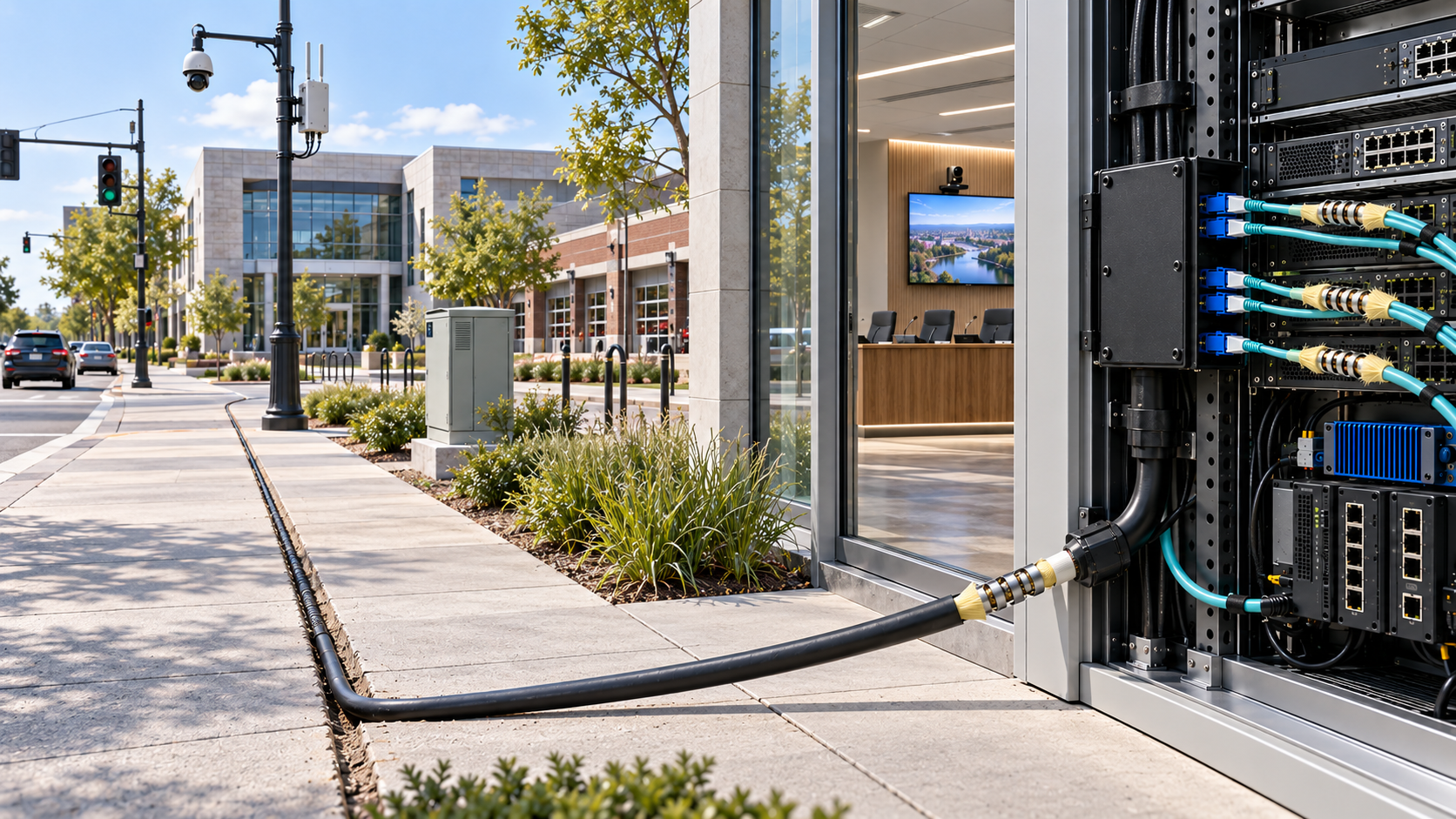
Iron Photon can coordinate the complete municipal route: a qualifying direct-burial backbone installed using small-OD or narrow-trench methods connects facilities and field cabinets, enters the approved building pathway, terminates in the communications room and transitions through armored patch cords to network, traffic, public-safety, DAS and AV equipment.
The image models this connection across a civic district. A black armored OS2 backbone follows a narrow underground route into a municipal communications room, then aqua armored LC patch cords connect the distribution enclosure to active equipment. A council or meeting room, traffic signal, camera and field cabinet show the wider municipal environment.
Government and Municipal Applications
Iron Photon armored fiber solutions can support:
- City halls, county buildings and administrative facilities
- Police, fire, emergency-management and public-safety facilities
- Traffic signals, cameras and intelligent transportation systems
- Water, wastewater, pumping and utility operations
- Libraries, community centers and public venues
- Schools, municipal campuses and government complexes
- Public Wi-Fi and community broadband infrastructure
- Security, surveillance and access-control systems
- Commercial cellular and qualifying public-safety DAS networks
- Council chambers, courtrooms and Professional AV systems
- Parking, transit and public-works facilities
- Data centers, network operations and continuity sites
Relevant Iron Photon Government Solutions
- OS2 singlemode armored fiber for citywide and interfacility links
- OM3, OM4 and OM5 multimode armored fiber where applicable
- Direct-burial constructions for approved routes and soil conditions
- Compact constructions suitable for qualifying small-OD or narrow-trench installations.
- Indoor, outdoor and indoor or outdoor cable designs where available
- Armored rollable-ribbon fiber for qualifying high-count routes
- Factory-terminated trunks, breakouts and armored patch cords
- LC, SC and MTP/MPO interfaces where appropriate
- Hybrid power-and-fiber for project-specific field equipment
- Power-over-fiber solutions for qualifying low-power endpoints
- Armored active optical HDMI and Professional AV connectivity
- Fiber supporting DAS headend, distribution and remote-unit links
- Qualifying TAA-compliant options by exact part number
- Custom labels, serialization, footage markings and test documentation
Final fiber type, construction, jacket, water blocking, burial method, fire rating, environmental suitability, power design, connector, country of origin and compliance status must be confirmed for the exact approved part number and procurement requirement.
Direct Burial and Small OD Trenching in Public Rights of Way
Traditional municipal fiber construction may require a wider trench, conduit, pull boxes, extensive restoration and a separate cable-pulling phase. For qualifying routes, direct-burial cable installed using small-OD or narrow-trench methods can reduce pathway materials, excavation, restoration and installation steps.
Potential project advantages include:
- Less excavation and backfill than many conventional trench methods
- Reduced conduit and pull-box requirements where approved
- Smaller restoration footprint across streets, sidewalks and public property
- Faster linear installation and earlier service availability
- Reduced duration of traffic, pedestrian and facility disruption
- Potentially lower total installed cost for qualifying projects
Results depend on permitting, right-of-way rules, utility locating, traffic control, pavement and soil conditions, drainage, approved depth and separation, crossings, water blocking, restoration, locating methods, future access and maintenance strategy.
Traffic Transportation and Smart Community Systems
Municipal transportation networks connect signals, roadside cameras, message signs, sensors, parking systems, transit assets and traffic-management centers. Armored OS2 backbones can support extended routes while smaller armored patch cords protect equipment links inside field cabinets.
Network topology, latency, redundancy, active optics, cabinet environment, electrical power, cybersecurity and system integration remain part of the approved transportation design.
Public Safety Emergency Response and DAS
Public-safety facilities and emergency-response operations depend on reliable communications among dispatch, operations centers, stations, cameras, radio systems and field locations. Fiber may also support approved public-safety DAS architectures connecting headend, distribution and remote equipment.
Coverage, active equipment, monitoring, backup power, survivability, fire requirements, testing and authority-having-jurisdiction acceptance remain responsibilities of the approved system design. Armored cable alone does not establish life-safety compliance.
Water Wastewater Utilities and Public Works
Municipal utility networks connect treatment plants, pump stations, remote sites, sensors, control systems and operations centers. Iron Photon can configure armored fiber around the required distance, pathway, environment, fiber count and equipment interfaces.
Moisture, flooding risk, chemicals, temperature, ultraviolet exposure, grounding, hazardous-location boundaries and equipment entries must be evaluated for the complete installation.
Data Rooms Civic Facilities and Professional AV
Inside government buildings, fiber connects data rooms, telecommunications spaces, AV racks, council chambers, courtrooms, training rooms, command centers, cameras, displays, digital signage and collaboration systems.
Iron Photon can coordinate armored backbones, equipment patching, AV-over-IP links, active optical HDMI and tactical event fiber around the facility. Bandwidth, latency, active equipment, source-display compatibility, fire rating and accessibility must be addressed in the approved design.
Security Cameras Sensors and Field Equipment
Fiber can connect security cameras, license-plate or traffic cameras, environmental sensors, access-control locations and field communications equipment over extended routes. Armored cable adds mechanical protection along outdoor and building pathways.
Camera performance, network bandwidth, equipment interfaces, environmental exposure, mounting, cybersecurity, monitoring and power must be designed as one system.
Hybrid Power and Fiber
Some municipal cameras, wireless equipment, sensors and remote systems require optical connectivity and electrical power. Iron Photon can evaluate project-specific hybrid assemblies combining fiber and copper conductors.
Voltage, current, conductor size, voltage drop, length, connector system, pathway, temperature, electrical code and equipment requirements must be engineered for each design. Hybrid cable is not a universal replacement for separately designed power and communications infrastructure.
Power Over Fiber for Qualifying Remote Devices
Power over fiber transmits optical energy and converts it into electrical power at the remote end. For qualifying low-power cameras, sensors, monitoring devices and communications endpoints, it can reduce dependence on local outlets and avoids adding copper conductors to the optical power channel.
The system requires an optical-power transmitter, compatible fiber path, photovoltaic converter, load management, power margin and laser-safety controls. Output depends on wavelength, source power, distance, losses, efficiency, temperature and equipment demand. Metallic armor grounding, bonding and isolation must be evaluated separately for the complete installation.
Procurement TAA and Documentation
Government procurement may require country-of-origin documentation, TAA compliance, approved manufacturers, domestic-content information, certifications, submittals and traceable test records. Iron Photon can identify qualifying options and provide documentation according to the selected configuration and contract requirements.
TAA compliance must be confirmed by exact part number and supply chain. It should not be presented as applying automatically to every cable, connector, active device or customized assembly.
Agency Contractor and Community Advantage
Government agencies, contractors and system integrators can benefit from:
- One coordinated armored platform from public right of way to indoor equipment
- Potential reduction in conduit construction for qualifying routes
- Compact armor for crowded pathways, cabinets and building entrances
- Factory termination that can reduce field labor
- OS2 and multimode options matched to distance and equipment
- Support for traffic, utilities, public safety, data, AV, DAS and cameras
- Hybrid power-and-fiber and qualifying power-over-fiber engineering
- Custom markings, serialization, testing and procurement documentation
- Scalable fiber capacity for future facilities and public services
Engineered Around the Complete Public Infrastructure Route
Iron Photon evaluates the agency requirements, facilities, route, right of way, network architecture, data rate, fiber count, burial method, field cabinets, building entrances, data rooms, traffic systems, utilities, DAS, AV, cameras, power, grounding, fire ratings, testing and documentation before recommending a configuration.
Direct burial, small-OD trenching, life-safety use, power delivery, environmental suitability, fire rating, TAA status and code compliance must never be inferred from armor alone. Each claim must correspond to the exact approved product, complete system design, applicable requirements and supporting documentation.
Connect Public Infrastructure From the Street to the Building
Tell us about the facilities, route, public systems, data rooms, transportation equipment, utilities, AV spaces, DAS, cameras, remote devices, bandwidth, pathways, procurement terms and power requirements. Iron Photon will help determine the armored backbone, building trunks, equipment patching, hybrid cable and qualifying power-over-fiber approach required for the project.