TransportationandDOT
Faster Protected Fiber Deployment Along Transportation Corridors
Iron Photon armored fiber supports transportation and DOT networks connecting traffic signals, cameras, message signs, tolling systems, roadway sensors, field cabinets and transportation-management centers. For qualifying routes, compact direct-burial constructions suitable for small-OD or narrow-trench installation can reduce dependence on conventional conduit systems, helping lower civil-construction requirements, shorten installation schedules and place protected fiber into service faster.
Faster Protected Fiber Deployment Along Transportation Corridors
Modern transportation infrastructure depends on fiber to move video, traffic data, control signals and operational communications among roadside devices, field cabinets, interchanges, facilities and centralized management systems. Expanding these networks can require long linear routes through active rights of way where construction cost, traffic disruption and deployment time are major concerns.
Iron Photon combines high-performance optical fiber with compact stainless-steel spiral armor. For approved projects, direct-burial cable constructions suitable for small-OD trenching or narrow-trench installation can create a more efficient alternative to installing a conventional conduit pathway before the fiber is placed.
The Direct Burial and Small-OD Trenching Value
Traditional conduit construction may require wider excavation, additional materials, multiple installation steps, larger restoration areas and more time before the fiber can be pulled. A qualifying narrow-trench installation approach cuts a narrow slot along the approved route, places the specified armored cable and restores the opening according to the roadway owner’s requirements.
When route conditions and specifications permit, the approach can provide:
- Less excavation, spoil removal and backfill than a conventional trench
- Reduced conduit, pull-box and pathway-material requirements
- Smaller restoration footprint along pavement or roadway shoulders
- Smaller installation equipment and potentially smaller field crews
- Faster linear production and shorter construction schedules
- Reduced duration of lane, shoulder and pedestrian disruption
- Fewer cable-pulling steps after pathway construction
- Earlier activation of cameras, signals, sensors and communications equipment
- Potentially lower total installed cost and faster speed to service
These advantages are project-dependent. Savings and schedule improvements must be evaluated against permitting, route preparation, traffic control, utility conflicts, surface restoration, approved depth, separation, soil and pavement conditions, cable protection, splice strategy and long-term maintenance requirements.
A Complete Route From Roadway Backbone to Equipment
Iron Photon can coordinate the protected optical path from compact bulk cable installed by direct burial or narrow-trench installation to the roadside fiber enclosure and onward through smaller factory-terminated armored patch cords. This protects both the long backbone route and the short equipment links inside field cabinets.
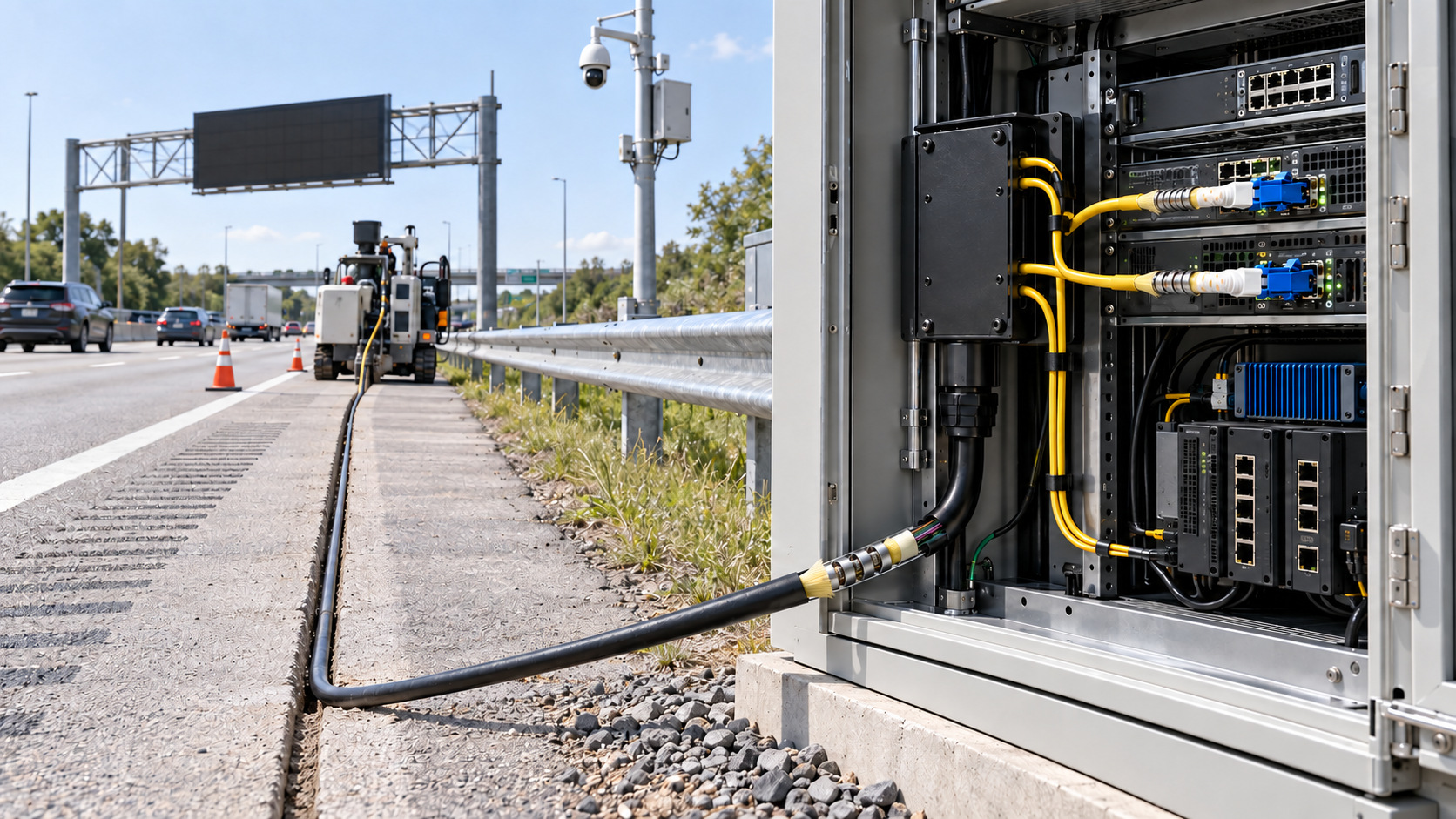
The image models this complete route: a black armored OS2 backbone follows a narrow roadway trench into an ITS cabinet, then yellow armored LC patch cords connect the fiber enclosure to network and traffic-control equipment. All cutaways remain proportional to the cable and show separated stainless-steel armor turns with visible gaps.
Transportation and DOT Applications
Iron Photon armored fiber solutions can support:
- Intelligent transportation systems and connected-roadway networks
- Traffic-signal interconnect and corridor coordination
- Roadside cameras and video-surveillance systems
- Variable and dynamic message signs
- Tolling, congestion-management and vehicle-detection systems
- Weather, pavement and environmental monitoring
- Roadside units and vehicle-to-infrastructure communications
- Fiber links among field cabinets, interchanges and management centers
- Bridge, tunnel and roadway communications
- Transit, rail and station communications
- Airport roads, parking and ground-transportation systems
- Emergency, incident-response and roadway-security networks
Relevant Iron Photon Transportation Solutions
- OS2 singlemode armored fiber for long roadway and interfacility links
- Direct-burial constructions for approved routes and soil conditions
- Compact cable constructions suitable for qualifying small-OD trenching or narrow-trench installation projects
- Indoor, outdoor and indoor or outdoor cable designs where available
- Loose-tube and tight-buffered configurations selected for the application
- Armored bulk fiber for backbone and lateral routes
- Factory-terminated armored LC and SC patch cords for cabinet equipment
- Custom trunks, breakouts, fiber counts, lengths and connector interfaces
- Project-specific print legends, sequential footage markings and labels
- Factory testing and documentation for qualifying cable assemblies
Final fiber type, water-blocking design, armor, jacket, outside diameter, bend radius, tensile and crush limits, burial depth, environmental rating, route, restoration system, connector interface and installation method must be confirmed for the selected part number and approved project.
Direct Burial Without a Separate Conduit Pathway
For a cable to be used in direct burial, the exact construction must be designed and approved for the intended underground environment. Stainless-steel armor provides mechanical protection, but armor alone does not establish direct-burial suitability.
Engineering must confirm water-blocking, jacket material, moisture resistance, crush performance, tensile limits, temperature range, chemical and ultraviolet exposure, rodent risk, soil conditions, burial depth and installation method. The route owner must also approve the cable placement, warning and locating method, separation from other utilities, restoration and future-access strategy.
Small-OD Trenching for Speed Cost and Reduced Disruption
Small-OD trenching can help agencies and contractors build long fiber routes with a narrower cut and smaller restoration area than many conventional trench-and-conduit methods. The value is strongest where a continuous approved alignment can be established along pavement, shoulder or another suitable transportation corridor.
A successful design requires coordination among the DOT or roadway owner, engineer, contractor, cable provider and restoration-system supplier. Slot width and depth, cable outside diameter, bend transitions, crossings, handholes, drainage, pavement condition, seasonal movement, backfill and sealant must be engineered together.
ITS Field Cabinets and Armored Equipment Patching
Roadside cabinets contain fiber termination, communications, control and network equipment supporting cameras, signals, message signs, sensors and other field devices. Short patch cords can be exposed during commissioning, maintenance and equipment replacement.
Iron Photon armored patch cords extend the stainless-steel spiral armor beneath the outer jacket toward the connectorized equipment link. Factory termination can provide the required fiber type, length, connector, polish, polarity and labeling while reducing field termination work.
Bridges Transit and Complex Routes
Transportation fiber may also pass through bridges, tunnels, stations, maintenance facilities and other structures where pathways, fire requirements, environmental exposure and access differ significantly from an open roadway route.
Cable construction and installation method must be selected for each segment. Direct burial or small-OD trenching must not be assumed appropriate where structural, fire, ventilation, drainage, vibration or access requirements call for another protected pathway.
Installer and Contractor Advantage
Iron Photon helps contractors coordinate the roadway backbone, cabinet transition and equipment patching within one armored fiber platform.
Installers and contractors can benefit from:
- Compact armored cable suited to qualifying direct-burial and small-OD trenching routes
- Potential reduction in conduit installation and cable-pulling steps
- Smaller excavation and restoration footprint where approved
- Faster linear placement and earlier system activation
- Added protection during installation and future roadway work
- Factory-terminated armored cabinet patch cords
- Custom lengths, fiber counts, breakouts, connectors and labels
- Sequential footage markings supporting route documentation
- Factory testing and project-specific documentation for qualifying assemblies
DOT Agency and System Owner Advantage
For transportation agencies and system owners, the value extends beyond the cable itself to the cost, schedule and operational impact of building the complete route.
Agencies and owners can benefit from:
- Potentially lower installed cost for qualifying routes
- Shorter construction windows and reduced traffic-control duration
- Less pavement or shoulder disturbance than wider trenching methods
- Faster deployment of traffic-management and safety systems
- Added mechanical protection for backbone and cabinet links
- Scalable OS2 capacity for future devices and corridor expansion
- Consistent cable identification and project documentation
- A coordinated fiber path from roadway route to active equipment
Engineering and Route Qualification
Iron Photon evaluates the complete transportation application before recommending a cable or assembly, including:
- DOT, municipal, toll authority, transit or airport requirements
- Route length, topology, redundancy and future expansion
- Fiber type, fiber count, bandwidth and optical loss budget
- Narrow-trench installation or direct-burial route geometry and approved depth
- Pavement, shoulder, soil, drainage and seasonal conditions
- Existing utilities, crossings, structures and right-of-way constraints
- Cable outside diameter, bend radius, pulling and crush requirements
- Water blocking, jacket, environmental and chemical exposure
- Splice locations, handholes, locating and future repair access
- Field-cabinet connector, breakout, patching and labeling requirements
- Testing, as-built documentation and acceptance requirements
As a typical guideline, minimum bend radius is 20× the cable outside diameter during installation and 10× after installation. Requirements vary by cable construction; confirm the applicable values for the selected cable and installation conditions.
Important Installation Qualifications
Direct burial, small-OD trenching or conduit-free installation must never be claimed solely because a cable contains armor. The exact part number must be approved for the application, and the complete route must comply with the project documents, governing specifications, permits, utility-clearance requirements and installation procedures.
Actual cost and schedule results depend on local labor, traffic control, equipment productivity, surface conditions, restoration requirements, permitting, mobilization, route continuity, splice count and project risk. Iron Photon should present lower cost and faster deployment as potential project advantages supported by route-specific evaluation, not as universal guarantees.
Build a Faster, More Protected Transportation Network
Tell us about the roadway or transportation application, route length, network architecture, fiber count, burial or small-OD trenching plan, pathway conditions, cabinet equipment, environmental requirements and project schedule.
Iron Photon will help determine the armored backbone, jacket, water-blocking design, factory-terminated armored patch cords, labeling and testing approach required for Engineering review and the approved installation.