Utilities
Protected Fiber for Critical Utility Communications
Iron Photon armored fiber helps protect the optical pathways supporting utility communications, automation, monitoring, protection and control. Compact stainless-steel armor and coordinated armored bulk-to-patch connectivity help utilities and integrators route dependable fiber through substations, control buildings, plants, campuses and field infrastructure while preserving pathway capacity and installation flexibility.
Protected Fiber for Critical Utility Communications
Electric power, water, wastewater, gas and other utility operations depend on communications networks connecting field assets, substations, plants, control centers and enterprise systems. Fiber provides the bandwidth, distance and electromagnetic immunity required for many of these links, but the physical cable remains exposed to installation activity, equipment changes and demanding pathways.
Iron Photon integrates flexible stainless-steel spiral armor around the optical core. The compact construction adds cable-level protection while maintaining the routing flexibility needed for cable trays, conduits, control cabinets, telecommunications rooms and equipment racks.
A Coordinated Bulk to Patch Architecture
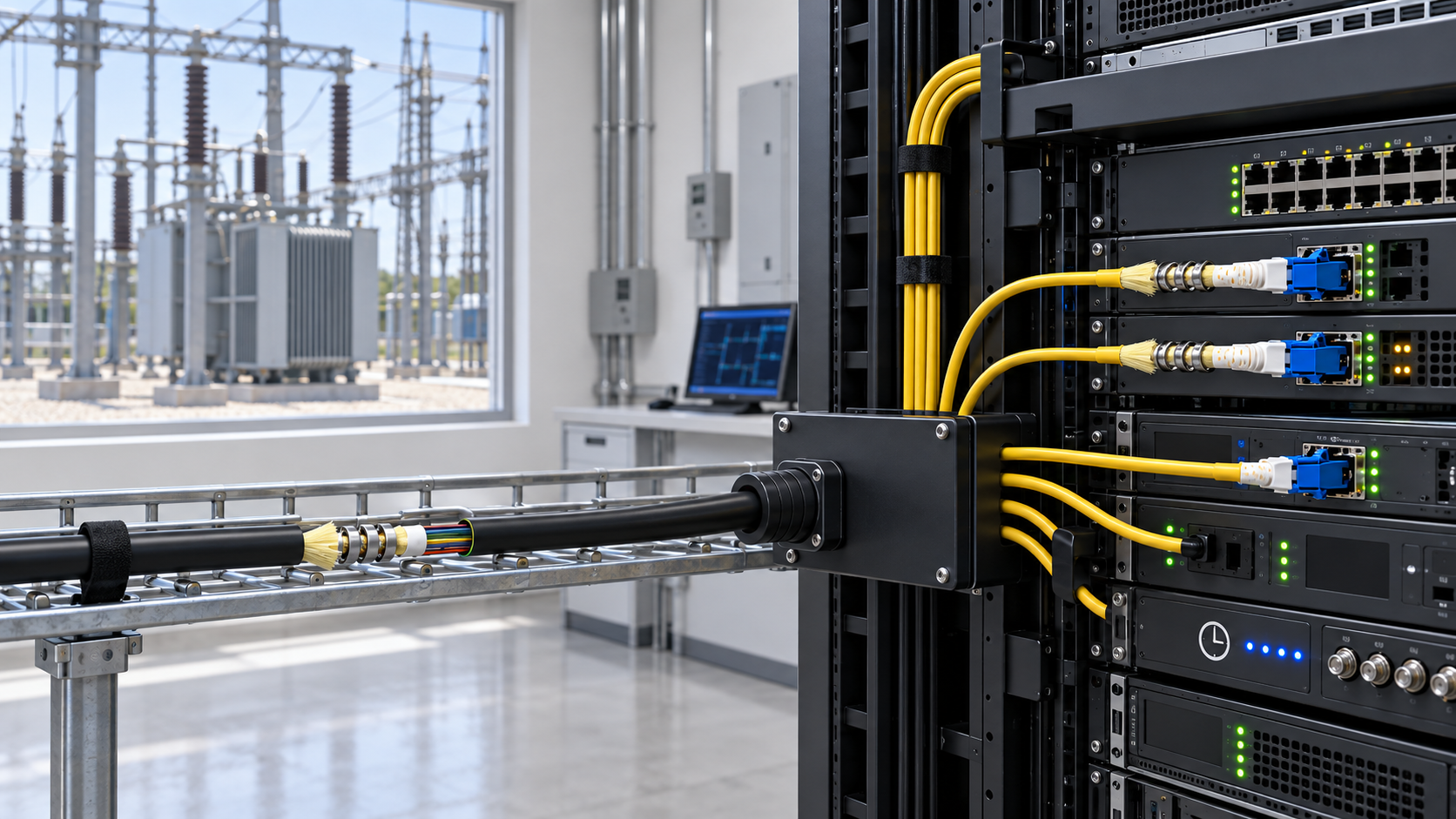
Iron Photon can coordinate the protected optical path from outdoor or indoor armored bulk cable through the fiber distribution enclosure and onward through smaller factory-terminated armored patch cords. This extends protection closer to switches, protection and control equipment, SCADA communications hardware and other active network interfaces.
The image models this route inside a substation control environment: a black armored OS2 backbone enters the distribution enclosure, then yellow armored LC patch cords connect to utility communications equipment. Each cutaway remains proportional to its cable and shows separated stainless-steel spiral turns with visible open gaps.
Utility Applications
Iron Photon armored fiber solutions can support:
- Electric generation, transmission and distribution facilities
- Substations and substation control buildings
- Protection, control and automation communications
- SCADA and utility operational-technology networks
- Water and wastewater treatment plants
- Pump stations, lift stations and remote process sites
- Natural-gas facilities and pipeline communications
- Smart-grid, advanced-metering and distribution-automation networks
- Utility data centers, network operations centers and control rooms
- Campus, interbuilding and field communications
- Security, surveillance and access-control networks
- New construction, modernization and qualifying brownfield upgrades
Relevant Iron Photon Utility Solutions
- OS2 singlemode armored fiber for extended-reach backbone and field links
- OM3, OM4 or OM5 multimode armored fiber where required by the approved architecture
- Indoor, outdoor and indoor or outdoor constructions where available
- Tight-buffered and loose-tube constructions selected for the pathway and environment
- Armored bulk fiber for substations, plants, campuses and interbuilding routes
- Factory-terminated armored LC and SC patch cords for equipment connections
- Custom trunks, breakouts and fanout assemblies
- Custom fiber counts, lengths, connector interfaces and labels
- Plenum, riser, low-smoke zero-halogen and project-specific jackets where available
- Factory testing and project-specific documentation for qualifying assemblies
Final fiber type, construction, outside diameter, jacket, environmental rating, listing, connector interface, grounding approach, pathway and installation method must be confirmed for the selected part number and approved utility design.
Electric Power and Substation Communications
Substations and power facilities use communications networks to support protection, control, monitoring, automation, timing, security and operational data. OS2 singlemode fiber can connect control buildings, equipment yards, remote facilities and network-operation locations across extended distances when paired with compatible equipment and a validated optical loss budget.
Iron Photon armored fiber can add protection along qualifying pathways within substations and control buildings. Product selection must account for routing, grounding and bonding design, electromagnetic environment, cable-entry method, environmental exposure, fire requirements and the utility’s approved engineering standards.
SCADA Automation and Operational Technology
SCADA and operational-technology networks carry information among sensors, controllers, remote terminal units, programmable logic controllers, communications gateways and control centers. Physical damage to a fiber link can interrupt visibility or control even when the optical design is otherwise correct.
Armored bulk cable and equipment patch cords can help protect the optical portion of these networks from incidental mechanical damage. Network architecture, redundancy, cybersecurity, protocol compatibility, latency, active electronics and failover remain part of the approved system design.
Water Wastewater and Process Utilities
Treatment plants, pump stations and remote process sites often combine indoor equipment rooms with outdoor or interbuilding routes. Iron Photon can provide project-specific armored fiber constructions around the required distance, fiber count, environment, pathway and termination method.
Moisture exposure, chemicals, ultraviolet exposure, temperature, flooding risk, conduit condition and hazardous-location boundaries must be evaluated for the complete installation. A general armored construction must not be assumed suitable for every environment.
OPGW and Utility Transmission Pathways
Optical ground wire is a specialized transmission-line product in which optical fibers are incorporated into an overhead grounding conductor. OPGW selection and installation require utility-specific mechanical, electrical, grounding, fault-current, sag, tension, hardware, splicing and environmental engineering.
Where Point 2 Point or Iron Photon supports an OPGW-related project, all cable, shielding, grounding, bonding and accessory requirements must follow the approved utility design and the exact manufacturer specification. Compact stainless-steel armored premises or field cable should not be presented as a substitute for OPGW.
Factory Terminated Armored Patch Cords
Equipment patch cords may be handled during commissioning, testing, maintenance and equipment replacement. Iron Photon armored patch cords extend the stainless-steel spiral armor beneath the outer jacket toward the connectorized equipment link while retaining a compact patch-cord profile.
Factory-terminated assemblies can be configured to the required fiber type, length, connector type, polish, polarity and labeling. Connector performance, equipment ports and optical budget must be verified before release.
New Construction Modernization and Brownfield Upgrades
New utility projects can coordinate fiber pathways, enclosures and equipment interfaces before construction. Existing facilities may require additional capacity through conduits and trays already serving active infrastructure.
Compact armored fiber can support qualifying modernization work where pathway space and mechanical protection both matter. Route surveys, fill calculations, bend requirements, pulling limits, outage constraints, grounding and bonding, firestopping and installation sequencing must be reviewed by the responsible project team.
Installer and Integrator Advantage
Iron Photon helps utility contractors and integrators coordinate optical fiber, protective armor, factory termination and labeling within one cable platform.
Installers and integrators can benefit from:
- Compact armored cable for crowded trays, conduits, cabinets and control rooms
- A coordinated transition from armored bulk fiber to armored equipment patching
- Added protection during pulling, placement, commissioning and equipment changes
- Factory-terminated assemblies that can reduce field termination labor
- Custom lengths, fiber counts and connector configurations
- Project-specific print legends, sequential footage markings and labels
- Singlemode and multimode options aligned with approved equipment
- Factory testing and documentation for qualifying assemblies
- A consistent protected platform from field backbone to equipment interface
Utility Owner and Operator Advantage
Dependable physical infrastructure supports operational visibility, communications continuity and long-term system maintenance.
Utilities and facility operators can benefit from:
- Added protection for critical optical pathways
- Reduced exposure to damage during maintenance and facility changes
- Better use of constrained cable trays and conduits
- Scalable fiber capacity for modernization and expansion
- Factory-defined assemblies that simplify replacement and future changes
- Consistent cable identification and project documentation
- A durable physical foundation for long-term network performance
Engineered Around the Complete Utility Fiber Path
Iron Photon evaluates the complete application before recommending a cable or assembly, including:
- Utility type, facility and operational purpose
- Network architecture, redundancy and active equipment
- Fiber type, fiber count, bandwidth and transmission distance
- Optical loss budget and connector-performance requirements
- Substation, plant, field, campus and interbuilding pathways
- Indoor, outdoor and environmental exposure
- Bend radius, pulling, crush and handling requirements
- Connector type, polish, polarity, breakout and labeling
- Jacket, flame listing and chemical or ultraviolet exposure
- Grounding, bonding and metallic-component treatment
- Testing, commissioning and documentation requirements
Engineering and Project Qualifications
All published claims and final configurations must be tied to the approved product specification. Engineering review should confirm optical performance, mechanical construction, fiber count, outside diameter, bend radius, tensile and crush limits, jacket material, environmental rating, flame listing, connector performance, metallic armor treatment and country-of-origin requirements where applicable.
Direct burial, aerial placement, OPGW use, hazardous-location suitability, fire survivability or installation without conduit must never be assumed from the presence of armor. Each claim must be supported by the exact approved construction, listing, test record and project design.
As a typical guideline, minimum bend radius is 20× the cable outside diameter during installation and 10× after installation. Requirements vary by cable construction; confirm the applicable values for the selected cable and installation conditions.
Build a More Protected Utility Fiber Infrastructure
Tell us about the utility application, network architecture, active equipment, fiber count, transmission distance, pathway, environment, jacket rating, grounding requirements and connector interfaces.
Iron Photon will help determine the armored bulk cable, factory-terminated armored patch cords, breakout, labeling and test-documentation approach required for Engineering review and the approved application.